The Feast of Yahawah
The Holy Days of our Elohim
The feast days of Yah are the days He gave us to celebrate and to remember the blessings of deliverance, forgiveness and the promise of His return. You might ask the question to why you may not have heard of these feasts and celebrations in the modern-day church? Most churches do not fill the need to acknowledge Yah’s days because they believe that they are only for the Jews. We understand that Yah gave these special times to His children to make of a special time or date to come. I guess the bigger question is, “Do you believe that you are a child of Yah and if so, why would you not be a part of His children.” Yah loves ALL of His children that are called by His name. We are His children…
As we move into these days that Yah has given and away from the pagan celebrated days of men, we will gain an understanding of each day and its meaning. Yah gave His people Holy Days, men transform those day into their pagan holidays.
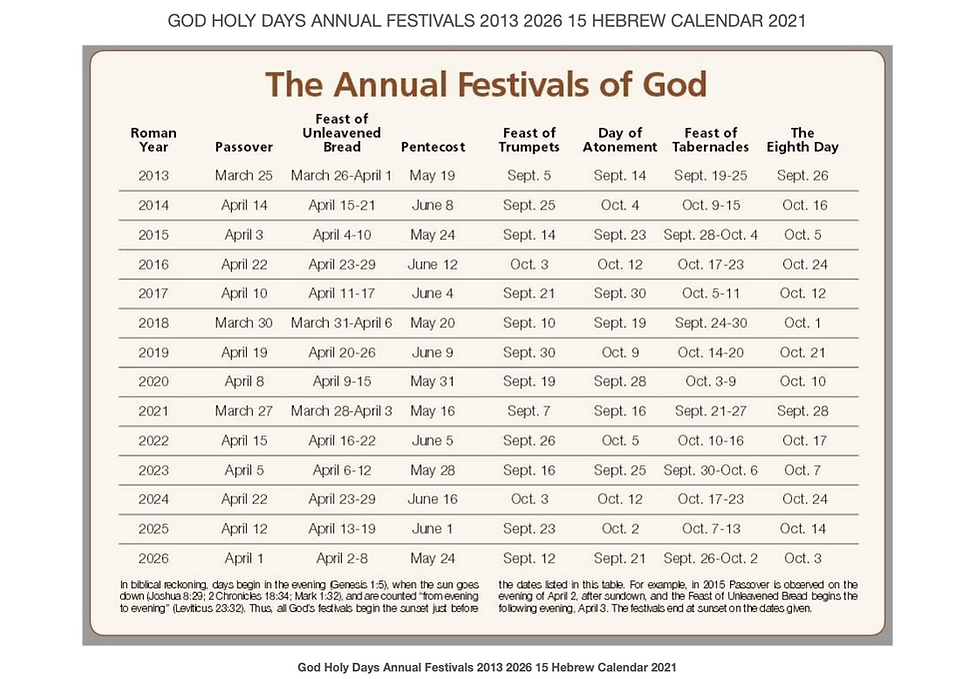
The calendar shared above displays the English calendar, the Hebrew calendar and the Holy days of Yah. First let’s discuss the calendar difference. We see that the Hebrew begins in the middle of month of March. This is very important to note as we should always keep this in mind as we discuss dates as this was of calendar method in those days. We will get into the 30-day monthly cycle and new moons and their relationship to the Hebrew calendar and High Sabbaths in another lesson. For this study we will only discuss the time difference and Feast Day of Celebration.
The Feast of Purin: March 14, 2025
The feast of Purin is a special holiday for the Hebrew/Jewish culture. This feasible is based on the biblical story of Esther. The story talks about how Haman, chief minister of King Ahasuerus wanted to have all Hebrews killed because Mordecai, a Hebrew refused to obey him so Haman went to the king and told him that the Hebrews were rebelling against him and should be slaughtered. The king allowed it and set a date for the execution of all Hebrews. When word reached Esther, a beloved Hebrew Queen of Ahasuerus and adopted daughter of Mordecai. She went to the king uninvited and suggested a banquet. At the meal she pleaded for the Hebrew and accused Haman for plotting to kill all of her people. The king was upset and left the meal, and, on his return, he saw Haman “falling on the couch where Esther was.” The king mistook Haman’s pleas for mercy as an attack upon the queen. The King was outraged and ordered Haman to be hanged. After all settled Esther and Mordecai obtain a royal edict allowing Hebrew throughout the empire to attack their enemies on Adar 13th. Once all was finished, they declared the following day a holiday and called it Purim.
When celebrating this holiday most people will start off with a day of fasting on Adar 13th, the day preceding the actual holiday. They also have a service and read the book of Esther. On Purim Hebrews also celebrate by exchanging gifts and making donations to the poor.
Passover Feast: April 12, 2025
Passover (Pesach) commemorates the exodus of the Hebrews from slavery in Egypt. The holiday started in the Torah, where the word pesach refers to the ancient Passover sacrifice (known as the Paschal Lamb); it is also said to refer to the idea that Yah “passed over” the homes of the Hebrews during the 10th plague on the Egyptians, where the first born would be taken. This holiday is the celebration and remembrance of how Yah passed over the ones who had the blood on the door post.
Passover is celebrated within 7 days (Feast of Unleavened Bread). During this week one will not eat any leavened food products like pasta or bread. Leavened is not eating because the Hebrews did not have enough time to wait for bread to rise. So instead they would eat matzah which is unleavened bread.
The Feast of Unleavened Bread: April 13th - 19th, 2025
The week of unleavened bread
“The Feast of Unleavened Bread is the first appointment in the year designated by YAHWEH our God to meet with Him in a holy convocation. The festival in itself extends over seven days with the first and the last days being high Sabbaths in which no work is done, and it is commenced by the Passover memorial. The instruction to observe this feast was given in relation to Passover and is linked to it and is a continuation of it. "These are the feasts of YAHAWAH, holy convocations which you shall proclaim at their appointed times. On the fourteenth day of the first month at twilight is YAHAWAH's Passover. And on the fifteenth day of the same month is the Feast of Unleavened Bread to YAHAWAH. On the first day you shall have a holy convocation, you shall do no customary work on it. But you shall offer an offering made by fire to Yahweh for seven days. The seventh day shall be a holy convocation; you shall do no customary work on it" (Leviticus 23: 4-8) See also Exodus 13: 4-10; Numbers 28:16-25; Deuteronomy 16: 2-4, 8.”
Pentecost: June 1, 2025
-
Christian festival celebrated on the seventh Sunday after Easter, commemorating the descent of the Holy Ghost upon the apostles; Whitsunday. Although most Christian believe this, Easter was actually a time of pagan worship of the goddess Ishtar (Easter or Venus). The Church later canonized Easter as " Resurrection Sunday", to cover and include those who followed these pagan practices.
-
Hebrew/Jewish festival, celebrated on the sixth and seventh days of Sivan by Orthodox and Conservative Hebrew outside Israel, but only on the sixth day by Reform Hebrews and Hebrews in Israel, that commemorates Yah's giving of the Ten Commandments to Moses.
It is the Hebrew festival of Shavouth (Shavout). It was originally a harvest festival, but now also commemorates the giving of the Law (the Torah).
What does the word “Pentecost” mean?
The English word “Pentecost” is a transliteration of the Greek word pentekostos, which means “fifty.” It comes from the ancient Christian expression pentekoste hemera, which means “fiftieth day.”
But Christians did not invent the phrase “fiftieth day.” Rather, they borrowed it from Greek-speaking Jews who used the phrase to refer to a Jewish holiday. This holiday was known as the Festival of Weeks, or, more simply, Weeks (Shavuot in Hebrew). This name comes from an expression in Leviticus 23:16, which instructs people to count seven weeks or “fifty days” from the end of Passover to the beginning of the next holiday (pentekonta hemeras in the ancient Greek translation of the Hebrew Scripture).
Shavuot was the second great feast in Israel’s yearly cycle of holy days. It was originally a harvest festival (Exod 23:16), but, in time, turned into a day to commemorate the giving of the law on Mt. Sinai. This day became especially significant for Christians because, seven weeks after the resurrection of Yahawashi (Yeshua), during the Jewish celebration of Shavuot/Pentecost, the Holy Spirit was poured out upon his first followers, thus empowering them for their mission and gathering them together as a church.
The Feast of Trumpets: September 21, 2025
The Feast of Trumpets marked the beginning of ten days of consecration and repentance before Yahweh. It is one of seven Hebrew feasts or festivals appointed by the Yah and one of three feasts that occur in the autumn. The Feast of Trumpets began on the first day (at the new moon) of the seventh month. Its name comes from the command to blow trumpets (Leviticus 23:24; Numbers 29:1-6). It is also called Rosh Hashanah, which means “Head of the Year,” because it marks the beginning of the present Jewish civil calendar. During this celebration, no kind of work was to be performed.
In the Leviticus passage, the words trumpet blasts are a translation of the Hebrew word teruah, which means “a shout” or “a blowing.” It appears that the shofar (ram’s horn) was to be blown at this time, as it was on the other new moons (Psalm 81:3). Hebrew/Jewish tradition indicates that both the ram’s horn and the priestly silver horns
(hazozerah) were used in the Feast of Trumpets.
The Feast of Trumpets was important for several reasons. First, it commemorated the end of the agricultural and festival year. Also, the Day of Atonement fell on the tenth day of this month, and the Festival of Booths began on the fifteenth day. The blowing of the trumpets on first day of the month heralded a solemn time of preparation for the Day of Atonement; this preparation time was called “Ten Days of Repentance” or the “Days of Awe.” The trumpet sound was an alarm of sorts and can be understood as a call to
introspection and repentance.
The Feast of Trumpets, along with the other six festivals of the Yahawah, foreshadowed certain aspects of the ministry of Yahawashi. The prophets linked the blowing of trumpets to the future Day of Judgment: “Blow the trumpet in Zion; sound the alarm on my holy hill. Let all who live in the land tremble, for the day of Yahawashi is coming. It is close at hand”
(Joel 2:1; see also Zephaniah 1:14, 16).
In the New Testament, we see that the Yahawashi’s Second Coming will be accompanied by the sound of a trumpet (1 Corinthians 15:51-52; 1 Thessalonians 4:16-17). Each of the judgments in Revelation 8-9 is also signaled by a trumpet. Just as the shofar called the Jewish nation to turn their attention to the Yah and ready themselves for the Day of Atonement, so will the “trump of Yah” call us to His coming and warn the world of coming judgment.
The Atonement: October 2, 2025
Leviticus 16:29-34 How this is a lasting ordinance
Yom Kippur (“Day of Atonement”) is the holiest day on the Jewish calendar. It is a time to repent of your sins and be assured of forgiveness through the atoning sacrifice of a lamb’s blood. It’s a day where we stop to reflect on the sacrifice of the perfect lamb, Yahawashi. In taking on the punishment for our sins, Yahawashi seals the promise of atonement, the promise of forgiveness and restored relationship with Yah.
The assurance of forgiveness was given through a ritual. In a tabernacle or temple with a special room the most holy place. Only the high priest was able to go in the room and he was only allowed once a year on the day of atonement. In that room was the arc of the covenant. Within the arc of the covenant was the law. The priest would then put the blood onto the arc in the forgiveness of the sins of the congregation or community.
Neilah the final service where the trumpet is blown to conclude the day of atonement and the fasting.
Many people on this day will fast from sundown to sundown, just as we would do for a regular sabbath. People also have prayer and fasting during this special holiday.
Leviticus 17: 11 “For the life of the flesh is in the blood, and I have given it to you upon the altar to make atonement for your souls; for it is the blood that makes atonement for the soul”.
The Feast of Tabernacles: October 7th – 13th, 2025
The feast of tabernacles or the feast of booths or in Hebrew the feast of Sukkot. This feast is all about remember when the Hebrews were brought out of Egypt and wondering in the dessert also it is to remember that God is with us always everywhere. This feast is for seven days, so this year 2020 it starts October 2-9, from Sabbath to Sabbath.
Most people go outside into their sukkot or their booth and what that is, is a temporary space outside. They build an outdoor wood frame and put palm branch leaves on top of their sukkot or booth and they would do everything in the sukkot such as worship, eating and some would sleep out there as well. The reason that they do this is to remind them that everything is temporary. Our houses, clothes, even our cars, but the one thing that is not temporary is our good deeds. Our good deeds when we give to others that’s eternal, when we pray and give thanks that’s eternal.
You can find where it talks about the feast of tabernacle in Leviticus Chapter 23:
33 Yahawah said to Moses, 34 “Say to the Israelites: ‘On the fifteenth day of the seventh month Yah’s Festival of Tabernacles begins, and it lasts for seven days. 35 The first day is a sacred assembly; do no regular work. 36 For seven days present food offerings to Yah, and on the eighth day hold a sacred assembly and present a food offering to Yah. It is the closing special assembly; do no regular work.
37 (“These are Yah’s appointed festivals, which you are to proclaim as sacred assemblies for bringing food offerings to Yah—the burnt offerings and grain offerings, sacrifices and drink offerings required for each day. 38 These offerings are in addition to those for Yah’s Sabbaths and[e] in addition to your gifts and whatever you have vowed and all the freewill offerings you give to Yahawah.)
39 “‘So beginning with the fifteenth day of the seventh month, after you have gathered the crops of the land, celebrate the festival to Yah for seven days; the first day is a day of sabbath rest, and the eighth day also is a day of sabbath rest. 40 On the first day you are to take branches from luxuriant trees—from palms, willows and other leafy trees—and rejoice before Yahawah your Elohim for seven days. 41 Celebrate this as a festival to Yah for seven days each year. This is to be a lasting ordinance for the generations to come; celebrate it in the seventh month. 42 Live in temporary shelters for seven days: All native-born Israelites are to live in such shelters 43 so your descendants will know that I had the Israelites live in temporary shelters when I brought them out of Egypt. I am Yahawah your Elohim.’”
44 So Moses announced to the Israelites the appointed festivals of Yahawah.
The Last Great Day or 8th Day of the Feast of Tabernacles: October 14th , 2025
The Last Great Day is also known as the eighth day. It is an independent festival from Tabernacles.
The Festival of Shelters begins on the fifteenth day of the seventh month and continues for seven days. On the first of these days come together for worship and do none of your daily work. Each day for seven days you shall present a food offering. On the eighth day come together again for worship and present a food offering. It is a day for worship, and you shall do no work (Leviticus 23:33 - 36)
Yahawashi kept the Last Great Day. It symbolized His ultimate offering, to all humans who have ever lived, the chance to repent and live forever with their Creator (John 7:37).
The Last Great Day has its own symbolism apart from the Feast of Tabernacles. It represents the time when Yah will make salvation available to all those who never had a previous chance to choose it (Revelation 20:4 - 5).
The Feast of Dedication (Hanukkah): December 15th - 22nd, 2025
The Festival of Dedication (Hanukkah/Chanukah) is celebrated for eight days beginning on 15 Kislev (the ninth Biblical month). For the Gregorian year 2025 it will be from Monday, December 15, 2025, through Monday, December 22, 2025. More accurately, with the day beginning at sundown this holiday actually begins on Sunday evening, December 15, and lasts until the end of daylight on Monday, December 22nd.
The Feast of Dedication is a day of celebration from oppression. When our people overcame the rule of pagans over us. Hanukkah isn’t one of the Appointed Times, or moedim, described in the Torah. In fact, Hanukkah didn’t come about until the Hasmonean period, long after the Babylonian captivity in Jewish history. There is no mention if it in the Tanakh (the Hebrew Bible, the Christian Old Testament), but there are detailed accounts of both the celebration and the events leading up to it in the Apocrypha in 1 & 2 Maccabees.
2 Maccabees 10:8 does say that “the whole Jewish nation should celebrate these days every year.” The account in 1 Maccabees extends this a little further:
Then Judas and his brothers and the entire congregation of Israel decreed that the days of the dedication of the altar should be observed with joy and gladness on the anniversary every year for eight days, from the twenty-fifth day of the month Chislev.
(1 Maccabees 4:59 NAB)
The Feast of Dedication is mentioned in the New Testament, in the book of John – though it might not be immediately recognized. The Hebrew word חנכת chanukkah means “dedication,” and the “Feast of Dedication” in our English Bibles is Hanukkah.
At that time the Feast of Dedication took place at Jerusalem; it was winter, and Yahawashi/Yeshua was walking in the temple, in the colonnade of Solomon.
(John 10:22-23 ESV)
Then came Hanukkah; it was winter in Jerusalem. Yeshua was walking in the Temple around Solomon’s Colonnade.
(John 10:22-23 TLV)